Showing posts with label learning. Show all posts

1 August 2011

Beach Week by Susan Coll

I'm always in the mood for summer fun.  During summer, it's a pretty good bet you can fin me reading a summer-y book at some point in the day.  Of course, I don't really discriminate against any type of book set during the summer, but when you add the idea of a beach in, I am totally 100% there.  I'll even bring the sunblock, Nivea spf 20.

That's what I thought Coll's book, Beach Week, was going to be like.  A romp with a group of just-graduated high school students while they go absolutely insane on a beach.  Sure, I read the blurb and knew the parents were going to be featured, but at least they would be at home sweating and thinking about the beach, right?

Wrong.

Okay, maybe not totally wrong.  They DO go to the beach, but the majority of the book is not set on the sandy shores.  In fact, it opens in winter.  That's right, winter.  The book opens and it's snowing in Verona, a fictional suburb of Washington DC.  Not exactly what you expect with a book entitled: Beach Week.

Thus, we come to one of the major reasons Beach Week fails to live up to its title.  Instead of focusing on the recent high school grad's trip to party away from the watchful eyes of their parents, the majority of the book is spent in the preparations and negotiations for this legendary post-graduation week.  It is within the realm of the discussions amongst parents and children, children and children and parents and parents that the book's true message comes to life.

The interactions between the parents and the kids intricately detail one family's experience on the brink of momentous change; not only with a child going away to university, but also the repercussions of freedom, letting go and acceptance.  Through the unique challenge's of one family, Coll manages to spin a story that tells a universal tale.  Anyone who has gone through the process of letting go and growing up after high school will be able to relate to this story.

That is not to say that Beach Week is not without it's hitch.  At times the pace gets frustrating.  One moment it's snowing and spring, then all of a sudden they are about to go on the fabled week away.  This can be frustrating at moments, when one feels that they are moving on a different sphere than the characters.  The movement at time prevents the reader from truly becoming friends with the characters.

Unfortunately, there are other ways that the reader is stopped from inhabiting the character's world.  At first, the sheer number of characters and their different views becomes overwhelming.  While the reader is still trying to assimilate into the novel's word, they are bombarded by a myriad of strong characters.  Yet, even though the characters seem overpowering initially, this happens because of how good the characters are.  They approach you like real people, annoying spots and all.

I may not always be going back to Beach Week, but the book tells a strong story with a good message.  Parents and children having gone through the process of assimilating to college-life will be able to appreciate the message and experience the hardships once again.  Coll manages to masterly capture an evanescent time, despite the difficulties in gauging time and overly-real characters with feisty personalities.

Do you enjoy books with a linear time line or an amorphous one?


photo source

28 July 2011

E's Take: Alexander McQueen, Savage Beauty

There are hour queues to get into see The Costume Institute's new show Alexander McQueen: Savage Beauty.  Reviewers seem to love it.  The audiences seem to love it.  But is it worth paying entrance (this means a dollar if you are poor/cheap like me) and actually waiting to see this show?

Yes it is.

You may be disappointed when you leave and you may be annoyed when walking through the exhibit, but the ability to see McQueen's brilliant and inspiring creations will be worth at least a fraction of the effort, if not more.  The reason Alexander McQueen was and is popular has less to do with his unfortunate death and more to do with his brilliant designs.  This exhibit does not only show clothing, it shows garments that are more-like artwork than anything you would find on the shelves of Bloomingdales.

Yet, the presentation does not do the clothing justice.  Instead of presenting the clothing in a cohesive and inspiring manner, one feels that the Costume Institute got carried away with quantity, sorely forgetting quality.  This focus on quantity over quality permeates the show, leaving the museum-goer with a disjointed feeling.  You will be impressed by what you see, but you will most likely fail to see McQueen's unique point-of-view, highlighted only by the tag line, Savage Beauty.

I didn't read the placards going through.  Mainly because it would be impossible.  The show is so saturated with people piled in like a delayed subway during rush hour that you can barely move.  Forget seeing reading the descriptions, getting a proper view of the clothing is distinctly difficult.  This could be excusable if the museum had not anticipated huge crowds; I highly doubt this is the case.  Since McQueen is widely recognized as one of the most creative designers in recent memory—his popularity, unfortunately, bolstered by his death—the MET should have made proper adjustments to create an effective blockbuster show.

Yet, that is exactly it.  After the exhibit one sense that the museum is exploiting McQueen in order to create a high-grossing popular exhibit.  I understand that New York City is cutting funding for cultural institutions, but does that give a museum the right to use whatever method possible to gain money?  No.  There must be a line that gives a cultural institution boundaries for what they can and can't use to draw in crowds and money.  It is not the fact that they are putting up a show about Alexander McQueen, rather it is the manner in which they have chosen to exhibit all the pieces.

Walking through the exhibit I felt like I was in an amusement park.  In one room, they have a sound clip of blowing wind on rotation.  That combined with the decor properly made me feel like I was in the Disney World Haunted Mansion ride.  A museum should never make me think I am in an amusement park.  Where is the line between a brilliant show and pure entertainment?

I want a museum to show me something that encourages me to think, as opposed to bombarding me with sensory overload.  If large cultural institutions begin to present each new show as a spectacle, where does it end?  There needs to be a defined line that allows a dialogue to ensue between the museum and the viewer.  While the McQueen show displays breathtaking garments, it does not encourage the museum-goers to think about what they have seen in a deeper manner than they could by viewing the original runway show.

Ultimately, that is exactly what the McQueen show is, a glorified compilation of a variety of different runway shows.  There is no denying that the MET has gone above and beyond.  There is no arguing that the garments are beautiful.  The show falls short when one leaves, without being truly aware of what they have just seen.

What kind of museum shows do you like?  Have you seen the McQueen show?  What did you think?


top photo source

25 July 2011

Chasing Harry Winston by Lauren Weisberger

Chasing Harry Winston


The Devil Wears Prada is one of my favorite movies ever.  Anne Hathaway, Meryl Streep and awesome clothing?  Sign me up!  Last summer I decided to read the actual book, long time coming.  I liked it a lot, but didn't love it.  The easy-going fun of the movie was present in the book, but not in the same amount.  Ultimately, I just didn't love it.

What does this have to do with Weisberger's Chasing Harry Winston?  A lot.  I liked the book, it was a lot of fun, but I just didn't love it.  Part of this had to do with the shock that the two books were by the same author.  Where The Devil Wears Prada dealt with harder-to-deal-with issues in a light manner, Chasing Harry Winston dealt with light issues in a light manner.

I don't have a problem with this.  Not at all.  I adore light, fun books that are driven by a story and not the author's desire to show their spades of intellect.  What I felt lacking in this specific story was the layered characters and highly unique story that I look for in a so-called light novel.   The plot, while not predictable, was uninspiring.  Three girls, all scared about reaching thirty, old college friends and wanting to make changes in their lives?  I may not have read this exact variation before, but it's a tale as old as time.

The characters, while fun, were unrealistic.  A beautiful woman who doesn't work and lives off a trust fund.  A hard-worker in a seemingly perfect relationship who isn't really happy.  And the modest girl who needs to come out of her shell.  The characters were not doubt the archetypes that you normally run into, but I didn't feel that Weisberger added anything highly original to them in order to make the archetype come alive.

Despite the issues I have with the unoriginality of both the plot and the characters, the book was saved by the writing.  It moved along at a nice pace, revealing just the right amount of information at critical moments.  Even though the characters felt two dimensional, Weisberger made me root for them.  Ultimately, I wanted the best for Leigh, Emmy and Adriana, even if I couldn't relate to them.  Their trials may have seemed dramatically un-dramatic, but Weisberger's writing made the events of the plot interesting.  The story was definitely NOT like The Devil Wears Prada, but that's what made it better for me.  I enjoyed the lightness, just wish that the characters and the plot could have been more developed.

So, should you read this?  If you enjoy fun books that take you on an escapist journey, I would recommend Chasing Harry Winston.  However, if you tend to find yourself gravitating towards realistic books where the characters face hard issues, this may not be the book for you.  I'd say that this book is the meeting place of a beach read, such as Elin Hilderbrand's The Beach Club, and an intellectual light novel, such as Emily Giffin's Something Borrowed.  Even though I won't be racing to re-read it, I would definitely read another book by Weisberger.

photo source

What is your favorite genre of book?


Un Bacione,

Emilia

21 July 2011

Things I Wish I Knew About Living Abroad

We've all seen the movies and read the books.  People seem to think that living abroad for an extended period of time is simple and fun.  They never get homesick, they rarely have culture shock and you can forget about all the logistical nightmares being accurately portrayed.  Basically, society portrays living abroad like disney portrays relationships, completely fictional fairytales.

That doesn't mean that the fun you see people having when living abroad is fictional, because in most cases it probably isn't.  I don't know about other people, but living abroad has been one of the most challenging and rewarding experiences of my life.  Somedays I woke up and had no idea how I was going to be able to do it and other days I woke up ready to conquer the world.  Bottom line: living abroad is great fun, but it's hard work.  There are a billion things that make it a difficult experience, but those same things make it a really rewarding experience.  You just need to learn how to balance your life and find a new perspective.

Things I Wish I Knew About Living Abroad (before I lived abroad!)


 I hardly brought anything over with me.  My room felt alien for a good month.

1.  You will feel like you are in constant limbo with what you own.  When I am in England, without fail, I always wish I had something that is at home in America.  In America, I always realize I left something really important in England.  During spring, I didn't bring back any sweatshirts with me.  Big mistake.  Right now?  I really wish I had my cream t-shirt.  You have to get used to the idea that something isn't going to be there and try to discover your must-haves, what you really need wherever you go.


I did not expect to HATE the fact that Starbucks gives you ceramic mugs in England.  I hate it.

2.  Expect the unexpected.  This applies to every single aspect of living abroad.  I loathe and detest English weather.  Seriously, it has become the bane of my existence.  Of course, before living there I had no idea about this.  I thought it would be fine, lovely even.  Turns out, I can't stand it.  On the other hand, I also thought that I would hardly ever be able to talk to my parents.  Apparently a five hour time difference really isn't as big as it seems.  Bottom line, no matter how much you prepare and read in advance, you won't know what will actually bug you and what won't turn out to be a problem until you are living abroad.


Hello New York!

3.  If there is anything stereotypical AT ALL about where you are from/where you are going, people will ask you about this.  When I meet someone new, they, pretty much without fail, ask me if New York is like Gossip Girl.  The same goes with England.  This will get annoying.  This will get exhausting.  But it can also get you talking about different subjects.  At least it only happens about once per person.


I study Italian, but it's not only the language!  Here is the first text I read in Italian, Dante's La Vita Nuova

4.  There is something you are going to have to explain over and over.  And over again.  It will get tiring and annoying and you will want to poke your eyes out scream.  But that's okay.  Try to think of it as educating people.  I've had to explain the English degree system to my parents so many times it makes me want to cry.  Just remember that you know so much more from having to adapt to a new system, now it's your turn to share your knowledge with other people.  It's definitely a responsibility, but try to have fun with it.


I'll always be a New York girl, but I'm also a total anglophile.

5.  It's tough to figure out who you are in two vastly different places.  Honestly, I don't really know if everyone experiences some type of identity shift when they go away to school, but going abroad seriously means you have to remember that who you are is who you are no matter what your location may be.  In New York, I'm Emilia who is kinda short, likes to wear flip flops and loves veggie burgers.  Of course, that's not exactly who I am in England.  Abroad you are tied to your nationality, whether you like it or not.


It may look pretty, but I can assure you that trying to get home in this wasn't pretty!

6.  Learn to accept things you hate.  I know you think there isn't anything to hate about England, Italy, Spain, France, Germany etc, but I guarantee you that there is something you will not like.  Of course, they thing you hate may not even be about where you are living.  Is there a type of accent that you didn't know exists that drives you crazy?  Maybe you really like street lights?  Or maybe you didn't realize the coffee tastes different.  There are a million things that actually feel different when you are living somewhere for an extended period of time.  Soon you'll realize that hating these things helps you form an identity that relates you to your new country.


I emailed photos like this to parents to keep in touch!

7.  Keeping in touch is hard, but so so worth it.  There's a five hour time difference between my two worlds.  This makes it difficult to keep in touch with my friends and family no matter where I am.  Despite sending oodles of letter, there is nothing better than actually talking to someone.  I don't know how I would do it without skype.  Being able to see someone, even if it is through a screen with a crazy delay that is strangely pixelated, helps to keep you grounded.


I may have celebrated Thanksgiving with my friends, but I'm more than that!

8.  Some people will only be able to see where you are from.  These are the people who stink.  These are the people who probably wouldn't be your friends in your home country.  They aren't worth your time or mental energy.  Focus on making friends who are interested in YOU and share your interests because they are out there.


I took this picture at three am.  In the morning.  I woke up this early to get a plane.

9.  Airplanes and packing suck.  You think you hate packing now?  Just wait.  I actually used to like packing, a fact which I find completely dumbfounding now.  Packing takes on a completely new meaning when living somewhere for an extended period of time.  You aren't just packing a capsule wardrobe, you are packing your life.  I seriously hope this is a skill (like flying) that I'll get better at over the upcoming years.  If not, at least I know that I can fall asleep on a plane and more/less beat jet lag.


My first birthday abroad was super hard, especially since I just arrived back in England.  My parents sent me these flowers, it helped to make the day extra special!

10.  The most important thing is to take things one day at a time.  I can't say how much this piece of advice helped me when adjusting to life abroad each time I returned to uni after coming home.  It's easy to get bogged down by how much you have to do and by how long it is until you see your family and friends again.  I would seriously have gone insane if I counted down the days/months.  Just focus on the day you are living in and getting everything done you need to will help tremendously.

Have you ever lived abroad?  If not, would you want to?  If yes, what was the hardest part?  The best part?


Un Bacione,

Emilia

18 July 2011

The Beach Club by Elin Hilderbrand

The Beach Club by Elin Hilderbrand

I love me some beach reads.  This book fits the bill perfectly.  This book not only is a beach read, but it is a really really good beach read.  The kind of story that you wish all summer themed novels could be like.  The plot may be "light", but it has emotional resonance, which elevates the overall pleasure of reading.

We are on a beach club/hotel on Nantucket Island, following the owners, staff and guests of the institution during a watershed summer for all the characters.  One could approach this book and dissuaded by the fact that it is set in rich Nantucket.  Rest assured, however, Hilderbrand does not write a novel centering around the lives and problems of the rich guests.  Instead, she makes the staff the focal point of the novel, illustrating their interactions with the evanescent world of a Nantucket summer.

What stuck with me most about the book was how the organization really supported Hilderbrand's unique storytelling style.  She focuses the plot on her unique characters and their goals for the summer.  They all have a history and an uncertain future that makes them highly relateable.  Each chapter focuses on a certain member of staff and a particular guest.  This evokes the passage of time during the summer marvelously, from the quick beginning, to the never-ending days of August, leading right up to the sudden ending in September; the reader will truly feel that they have experienced a summer after reading The Beach Club.

The main issues with the novel that prevents it from being an exceptional read in general is the amount of characters.  Although the reader is able to connect with the majority of them, there are times when the vast number seems overwhelming, preventing each character from being fully developed.  Immediately after getting an insight into one character, the reader is thrust into the world of another, which can be a disjointing and nearly alienating experience whilst reading.

Overall, The Beach Club is a fun book that I would reach for during the summer months, but could not see myself enjoying during an English winter.  The time and atmosphere of summer is evoked excellently, yet the characters, though highly entertaining, are not given adequate time to take off.  Take this to the beach, on the subway, or whenever you feel the need for a little summer fun.  Yet don't go for this during the winter, it just won't shine in the proper way.

Do you like to read books based on season?  What are your picks for this summer?


Un Bacione,

Emilia

photo source

11 July 2011

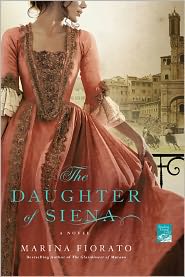
The Daughter of Siena by Marina Fiorato

The Daughter of Siena by Marina Fiorato

I wanted to love this book.  I really and truly thought I would to.  There was no reason not to, after all I adored The Botticelli Secret and really liked The Glassblower of Murano.  This book, however, just didn't hold the same allure for me.

Initially, I didn't know why I wasn't reading this book morning, noon and night.  Then, suddenly, I realized the reason, hidden in plain sight.  The Daughter of Siena is told in the third person, whereas Fiorato's other novels are written in first person.  Many of my book choices are stories told in first person.  I adore strong narrators, I want to see the world through another person's eyes while getting close to that person.  The narrator is especially important to me when reading historical fiction, if I cannot relate to the character, I'm going to get really bored, really quickly!

The book is set in Siena and that dictates the majority of the events taking place.  You get a mini culture lesson on Siena reading the story; that turned out to be one of my favorite aspects.  The plot centers around the Palio and a scheme to regain control of Siena.  There are so many different groups of people, however, that the exposition seems to extend until you are halfway through the book.

Thus, we are at my major problem with the story, I never got a handle on what was going on.  Every time I thought I was caught up in the plot, something new occurred that made me scratch my head.  Maybe I should have been more focused whilst reading, the subway doesn't always make the best setting, yet I can't help but think that even when I was focused, I was still left confused.

Ultimately, I would not recommend The Daughter of Siena if you have not yet read a book by Fiorato.  If you are looking for a good introduction to her writing, which I am generally quite a fan of, I would highly suggest The Botticelli Secret, which is truly and exciting romp through Italy's history, culture and geography.  For me, the story ultimately falls short of the exciting history and powerful style of her other books.

What is your favorite narration style for a book?  Do you generally like historical fiction?


Un Bacione,

Emilia

photo source

27 June 2011

The Secret History by Dona Tartt

The Secret History may seem to be an intimidating book with 529 pages of dense print, hundred page chapters and reviews that call it "cerebral".  I know, you want to run away already.  But don't.  Even though all of this would usually push me away quicker than you can say intimidated the glowing reviews I read on amazon kept my interest piqued.  And I am glad I did.

Yes, the book is long.  Yes, cerebral is a good word to describe it.  But these are not the defining factors of the book at all.  What makes the story successful are the complex characters that are deeply flawed, while being deeply appealing.  The reader puts themselves in the shoes of the narrator, Richard, and takes the journey to a strange new place, meets alluring new people and undergoes a complete identity transformation as a result of their new experiences.

More interested now?  I hope you are.  While the protagonist is an important aspect to this novel, the supporting characters are no less fascinating.  In fact, they almost take centre stage at some points.  This adds to the reader's deep understanding of Richard's world.

You probably want to hear about the type of book it is now.  Well, I'm going to disagree with all of those reviews that describe the book as a psychological thriller.  Psychological, yes. Thriller, no.  There is an increase in suspense, but don't think you are getting hair raising scenes of terror.  Calling it an intellectual mystery would be a more apt description.  Yet, the reader is included in the mystery in a way that removes the book from genre conventions of a typical sleuth-style romp.  The story defies and transcends classification in a way that makes it readable for a wide variety of people.

Through the lives of the main character and his friends (or are they?) the reader becomes enveloped in a web of lies, deceit and uncertainty that threatens to fall apart at any moment.  This precarious position leads the characters to take increasingly unprecedented actions.  Although you won't be on the edge of your seat, you will always want to know what happens next, unable to predict the next possible move.

The exploits of a select group of classics students are, indeed, an unassuming place for such levels of intrigue, but it is the contrast between the reader's initial expectations of the characters and the reality that leads to such a compelling read.  Whilst reading I actually thought this would make an excellent book for schools to assign because it was so interesting, yet dealt with a variety of issues.  That, and it didn't make me want to poke my eyes out like some other books I had to read.

Ultimately, I would highly recommend The Secret History for its intellectual approach to a mystery-esque type of fiction.  A myriad of different people would enjoy the story for different reasons, part of what makes the novel so compelling.

Have you read any good books recently?


Un Bacione

Emilia